
Guest Essay: How Mathematics Found Me
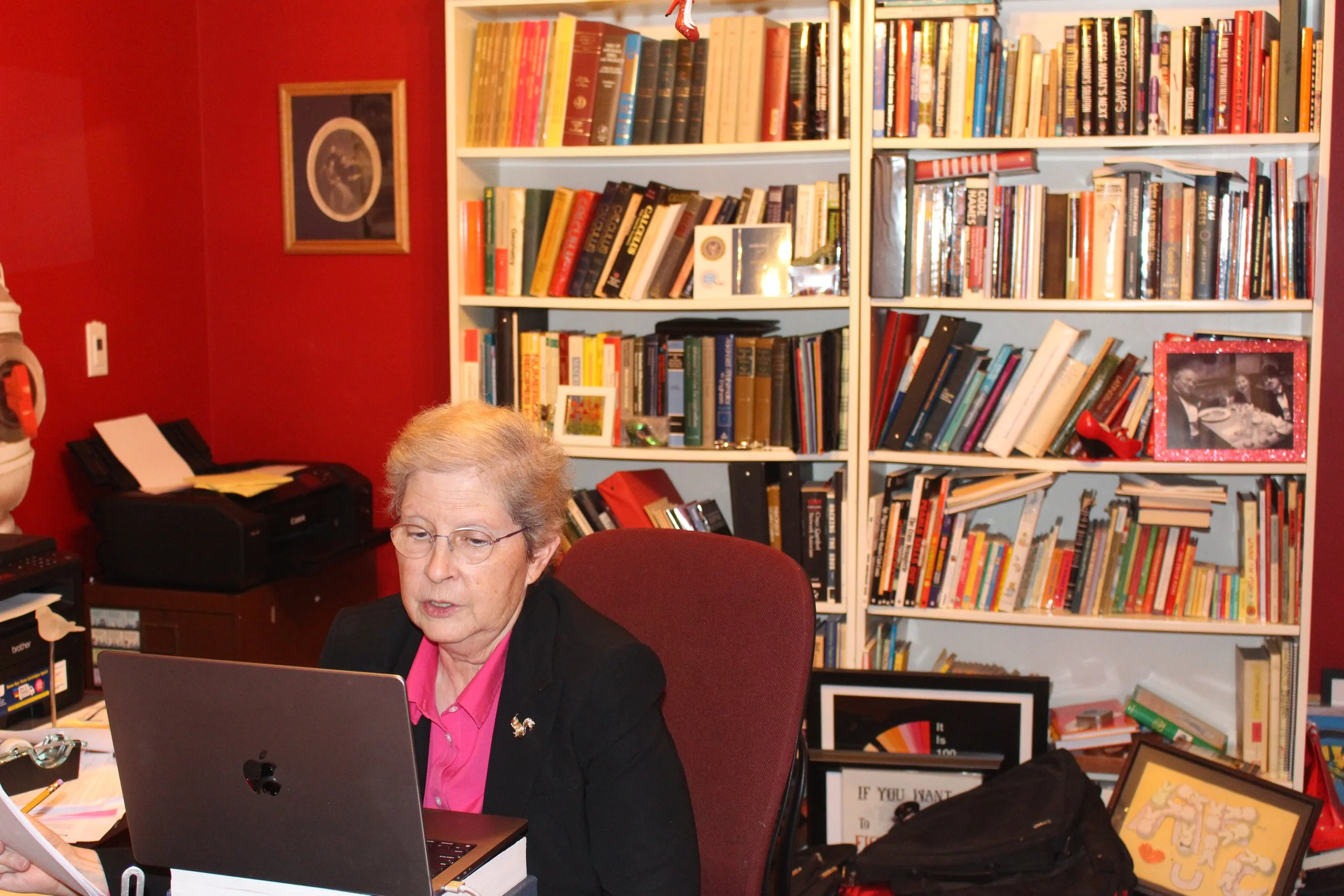
Dr. Leslie Gruis
Author of The Privacy Pirates and Privacy Past, Present and Future
And you may find yourself living in a shotgun shack . . .
And you may ask yourself, “Well, how did I get here?”
- Talking Heads, “Once in a Lifetime”
I know exactly how I got here. I was born a patriot to parents who lived on Capitol Hill. My mom worked for a congressman, and my dad worked for the Federal Trade Commission. When I was four, I remember them taking me to see President Kennedy lying in state in the Capitol rotunda and thinking, “I need to make a memory; this is important.”
I was lucky. I had amazingly progressive parents who believed their daughter could grow up to do anything. When I showed an early aptitude for math, they encouraged it. I attended private schools across town—first Beauvoir, then the National Cathedral School for Girls (NCS)—where I was always encouraged to be whatever I wanted to be.
Except once. I remember in first grade, a boy with an aptitude for math got to take the second-grade standardized math test. I didn’t, and I thought it was very unfair. Despite the steps my parents had taken to shelter me from the biases of the world, I encountered the glass ceiling when I was only seven.
One of our neighbors on the Hill was a kindly old gentleman with a pencil-thin moustache and a beret who lived a couple of doors down. He would often stop and talk to me. When he heard I loved math, he encouraged me. Only later did I understand that he and his wife were the father and mother of American cryptology; NSA’s William and Elizebeth Friedman Auditorium is named after them. At five, I was already on the path to succeed them in the ranks of government codebreakers and codemakers. Maybe it was fate.
Air conditioning was not yet available in homes when I was very little. Given the insufferable summer heat and humidity of the Washington swamp, my parents came up with a unique solution. My mom packed up the kids and the dog and drove to the Midwest to stay with her dad on the farm. Outside Muncie, Indiana, the farm was an idyllic place where kids could get lost in outdoor adventures and remain relatively safe.
I felt an affinity with the Midwest. Life was slower, simpler. I had other family there. It wasn’t the hustle and bustle of the city where I spent the other nine months of the year. It was more like a refreshing glass of lemonade that you sat and savored on a lovely summer afternoon.
I graduated from high school and headed off to the University of Chicago. I was the first NCS graduate to attend U of C; most of my classmates stayed on the East Coast. I was sick of being around East Coast preppies who always made me feel like I didn’t belong because I was smart and liked math. It helped a lot that I’d spent lots of time in the Midwest growing up. Besides, my dad was from Chicago.
Attending the University of Chicago was a big adventure. My peers were all misfits like me: incredibly smart individuals who never really fit in in high school. Discovering there were others like me was both a solace and a comeuppance. We studied hard and partied hard.
I loved the liberal arts program at Chicago. The university’s Great Books orientation required all students to read the great Western thinkers and debate weighty questions. I fulfilled the foreign language requirement with an AP credit, but still took one class in French poetry. I adored two classes I took on nineteenth and twentieth-century American social movements. I completed my least favorite requirement—one year in the biological sciences—with non-lab classes.
And then I met math at the university level, and very quickly realized that I far preferred applied mathematics to pure mathematics. Abstract algebra was torture; linear algebra and programming were delights.
After graduating from the University of Chicago, I went on to Northwestern University to study in the new graduate department of Applied Mathematics and Engineering Sciences. The program was located on the third floor of the Technological Institute (now the McCormick School of Engineering). One thing I remember is that you had to walk what seemed like miles to find the women’s bathrooms, as if they were an afterthought. I was one of two women in the program; the other was a Polish woman who was very smart. I had problems getting an advisor within the department, so I ended up with a professor of physics and astronomy. I took graduate classes in quantum mechanics and electrodynamics. The latter—the only place I ever encountered tensors—was the toughest class I ever took. I completed my PhD with a dissertation in statistical mechanics.
Through the university’s job placement service, I got an on-campus interview with the National Security Agency (NSA). I done my homework, having digested James Bamford’s 1982 NSA exposé, The Puzzle Palace: A Report on America’s Most Secret Agency. The interviewer cringed when I proudly recited alleged “facts” about the Agency. Nonetheless, he gave me a fat package of questions to complete so NSA could begin the background investigation for a security clearance.
I was eventually invited for an in-person interview at the NSA. On-site, I had a polygraph, a math test, and interviews with people who couldn’t tell me what I’d be doing. I expressed my preference for the office where the escorting interviewer gave me a bathroom break. It took nine months for the security clearance to come through, but I got the job. I started in 1987.
Life at NSA was my next big adventure. I transferred into the Cryptologic Mathematician Program, a three-year development program for math interns who toured in five or six offices and completed a set academic curriculum. I graduated from this program, and ended up working in many different fields, like electrical engineering, big data, computational linguistics, physics, intelligence analysis, and cybersecurity. I changed jobs frequently to keep the challenges fresh.
There are four specific highlights from my career I’d like to share. First, I joined the NSA shortly before the Soviet Union fell and the internet exploded. I got to see the old NSA fighting the traditional Cold War opponent when analog communications systems still reigned supreme. The big change came in 1991, when the USSR fell, and the internet began to emerge. NSA retooled itself and its workforce for a digital world of ubiquitous communications. It’s a remarkable thing to see what you think of as a stodgy government agency adapt relatively quickly to a new set of emerging parameters. It was impressive.
A second highlight was NSA’s Women in Mathematics Symposium. The senior female mathematicians at the NSA were concerned that they didn’t have a big enough voice in the male-dominated mathematics community. The NSA was not attracting enough women in mathematics. I helped organize this 1993 symposium, in which over 100 academics, largely women mathematicians, were invited in from universities across the country to hear about job opportunities at NSA. The event was a huge success; a symposium proceeding was published.
What grew out of that was the NSA’s own Women in Mathematics Society. I was its first president, and it continues to maintain contacts with the academic community today.
A third highlight was my assignment to USCYBERCOM (2013-2015). Yes, I’d been working for the Department of Defense for 25 years, but I’d never served in a military command where almost everyone wore uniforms. The command had a different rhythm, a sense of excitement, like what you did mattered every day to the folks who were on the front lines of cyber defense and offense for the military. This was the first time I understood the different nuances of language used by people empowered under Title 10—Armed Forces Law—versus the Title 50 code that governed the intelligence community. I actually did a lot of policy work, cross-walking USCYBERCOM policies with DoD and NSA policies and regulations. It was a fascinating and, at times, frustrating puzzle to unravel.
A final highlight was my time working at the National Intelligence Council (NIC) at the Office of the Director of National Intelligence (ODNI). I had had other assignments at the ODNI before, but this one was special; I got it because I had the chutzpah to ask a senior to create it for me. The NIC authors National Intelligence Estimates (NIEs) on U.S. concerns, like North Korea, climate change, and Chinese Space Activities. Still a history buff, I knew the origins of the NIC lay with World War II’s Office of Strategic Services (OSS, the predecessor of the CIA). The NIC is a collection of really smart visiting academics and civil servants like me who study the problems of our day and author intelligence community-coordinated views. I got to work for the National Intelligence Officer for Cyber, a lawyer who was adeptly shepherding a fairly new portfolio. I will never forget it. It was the cherry on top of a series of remarkable assignments over my 30-year career.
My decision to retire in 2017 and start writing books about privacy evolved quite naturally. Early in my career, I’d had to sit with the NSA lawyers and explain the capabilities of the technology my branch had created to ensure it respected privacy rights. Having grown up on the Hill with a lawyer for a father, I was very accustomed to talking with lawyers. The attorney and I were able to get to yes quite easily; the technology was legally approved.
In 1999, I read the new book Code and Other Laws of Cyberspace by the attorney Lawrence Lessig. This book was among the first to explain how internet technology would rock the norms of legal intent and challenge the privacy expectations of our democracy. It made a huge impression on me.
All this curiosity and dabbling with legal ideas was leading up to something, but I didn’t see it until I went to the NIC. My lawyer boss was happy to spend hours answering my questions on how cyber technology challenged existing privacy law. Finally, he looked at me one day and said, “You’re so interested in this subject, why don’t you write a book? You’re perfectly capable of it.” When I retired from NSA, shortly after returning from the NIC, I did just that.
I’d already had a lifetime of practice explaining difficult things in simple terms. Long before I became that NSA mathematician explaining technologies to lawyers, I’d tutored my NCS classmates in math over the phone for hours. By the time I wrote my first book, Privacy Past, Present, and Future, I was able to describe—in non-technical, non-legal language—how US privacy law had evolved with communications technology. In the second, The Privacy Pirates, I distilled the story of US privacy and technology down into 100 pithy pages suitable for all Americans.
Along with my writing, I also tutor mathematics, physics, English, and history for secondary school students. I’m sowing the seeds for the next generation of STEM professionals. My sweet spot is all my middle school girls, who are prone to losing faith in their mathematical abilities during adolescence. As a living, breathing model of that rare female mathematician breed, I’m there to remind them that they can become anything they want.